Insurtech 50: The Most Promising Insurtech Startups of 2026
This article was originally published on CB Insights: https://www.cbinsights.com/research/report/top-insurtech-startups-2026/
In 2026, insurance’s top startups embrace practicality over hype.
This practicality is the result of a competitive environment where AI is table stakes, and the ability of incumbents to build quickly with LLMs has eroded speed to market as an inherent advantage for most startups. 27 of this year’s Insurtech 50 winners were founded in 2022 or later, meaning a majority of the winners launched and scaled their businesses as the likes of Anthropic and OpenAI entered the mainstream.
The 2026 Insurtech 50 winners reflect the next generation of insurtechs where leaders are increasingly specialists rather than generalists in their domains. The winners demonstrate clear traction, and their common thread is a shared outlook that indicates they’ll keep gaining ground on much larger incumbents and other startups.
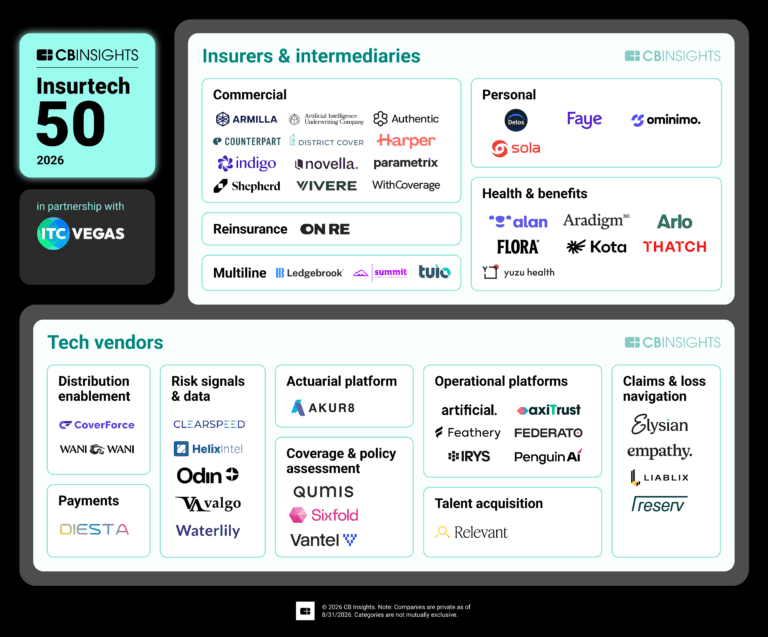
Below, we map out the 50 winners, classifying them across 13 categories based on their core offering. Then, we break down the key takeaways among this year’s winners:
AI capabilities alone are rarely a competitive differentiator.
Most product offerings would be difficult to displace by a larger incumbent.
A select few investors have an outsized impact on the industry.
CB Insights Insurtech 30, 20026
Methodology: We selected 50 winners from 6K+ insurtechs using deal activity, industry partnerships, investor strength, hiring momentum, revenue, and CB Insights’ predictive scores for success (Mosaic Score) and commercial traction (Commercial Maturity). We also analyzed Executive Interviews submitted directly to us by startups. Note that exited insurtechs were excluded from consideration.
Key Takeaways
1. AI capabilities alone are rarely a competitive differentiator.
AI is relevant to all of the 2026 Insurtech 50 winners. That said, what generally distinguishes the winners is their ability to differentiate AI usage (e.g., industry backing, reputation, proprietary solutions, etc.) to create a distinct business moat. Examples include:
WaniWani, which demonstrated a first-mover advantage in AI distribution due to its partnership with Tuio for quoting within ChatGPT.
These business moats are critical since they signal the winners are durable startups capable of being long-term, viable partners. This is especially critical for the tech vendors given their need to win long-term trust from carrier and broker partners, as highlighted by Cyrus Karai, Co-Founder and CEO of CoverForce, in his interview with CB Insights:
“The single biggest investment CoverForce is making over the next 12 months is AI, in a big way. Our customers are hungry for it — every broker, wholesaler, and carrier we talk to is asking how AI can help them do more. But here’s the philosophy that sets CoverForce apart: AI is not a standalone solution.”
2. Most product offerings would be difficult to displace by a larger incumbent.
Disruption has always been a core insurtech theme, but insurtech startups no longer have the unique advantage of being the industry’s principal disruptors. As a result, most of the 2026 Insurtech 50 winners have distinct and differentiated product offerings within the marketplace. Examples include:
Clearspeed, with unique domain expertise across both government and insurance.
Counterpart, which claims its loss ratios outperform the industry by more than 10 points.
Odin Space, which builds collision-detection hardware for satellites that support loss prevention efforts and claims filing.
Summit, a tech-enabled brokerage specifically for Canadian businesses.
The winners generally employ one of two strategies: outperform competitors or enter markets others avoid. Sola Insurance Co-Founder and CEO Wesley Pergament’s CB Insights interview reflects this view, stating:
“But we find we win in really most of the country now, because the chance that a homeowner has an affordable home insurance policy with a low wind and hail deductible is very slim.”
3. A select few investors have an outsized impact on the industry.
440 investors have participated in deals involving the 2026 Insurtech 50 winners. Just 11% have backed multiple winners, and the top six venture investors by portfolio company count have together backed 36% of the list:
General Catalyst: Arlo, axiTrust, Empathy, Thatch, Vivere, Yuzu Health
The challenge is that only 7 of the investors backing multiple winners are corporations or corporate venture firms, which reduces visibility into leading startups among the industry’s established players. This is a challenge since investment provides differentiated access to the startups, as Leslie M. Lee, CMO of Thatch, shared with CB Insights:
“The partnerships that have become most strategic to our growth are payroll platforms and brokers. What makes them interesting right now isn’t just the volume they send us — it’s that they’re becoming investors too.”
The 2026 Insurtech 50: By the data
Quick facts on this year’s list
Raised $3.0B in equity funding over time, including more than $0.8B in 2026 so far (16% of YTD insurtech funding).
Disclosed 70+ partnerships since 2025, including with industry leaders like ADP and Marsh.
Includes 31 early-stage startups, 14 of which are at the seed stage.
Employs 5,400+ people, with a median headcount of 52 across the cohort.
Ranks among the top 4% of private companies globally for overall health and growth potential (by Mosaic Score).